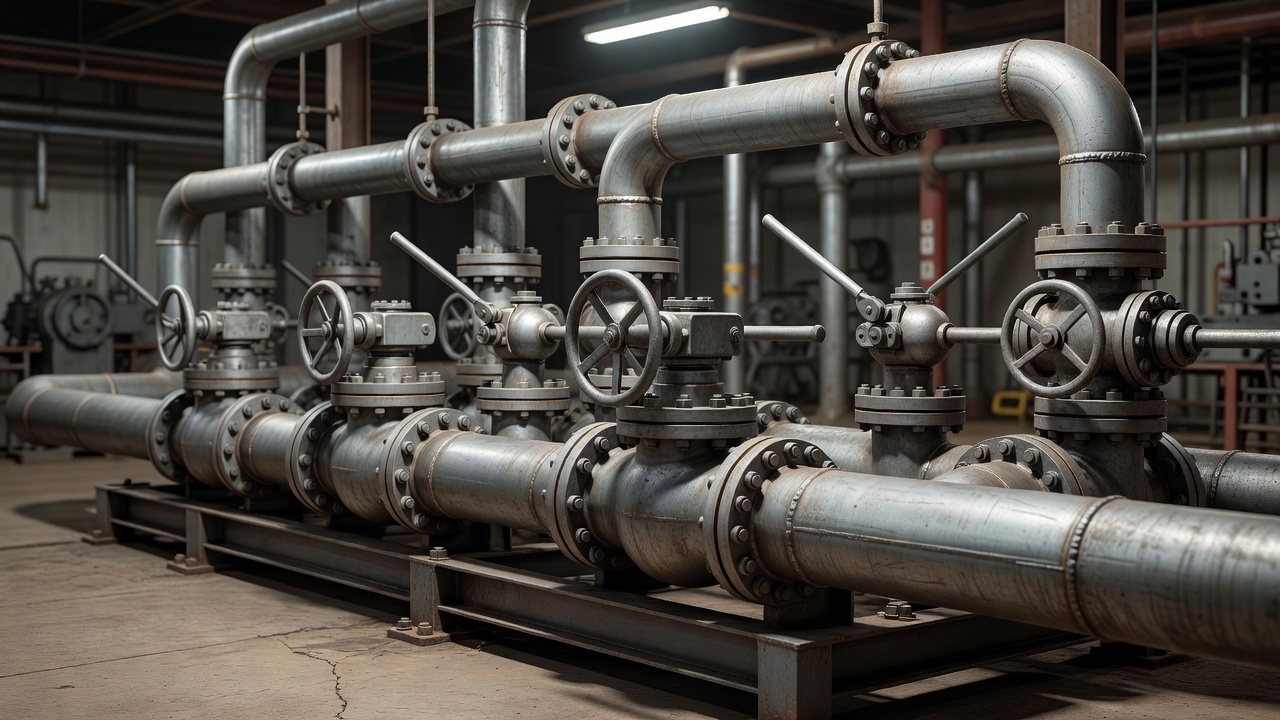
A hydrogen storage site sits within a wider network of production, conditioning, transport and use. The facility interface is where those parts meet. It may be a pipeline connection, a delivery bay, a transfer assembly or a boundary between a storage process and an industrial user. The physical connection matters, but so do metering, operating responsibilities, information exchange, access and the assumptions that shape a supply agreement.
Start with the route
Hydrogen may arrive by pipeline, road vehicle or a project-specific transport arrangement. A site may also be integrated directly with production. The appropriate route depends on geography, demand, infrastructure availability and project design. Each route brings different requirements for receiving, conditioning, measurement, scheduling and onward delivery. A route map should identify whether the depicted connections are existing, planned or conceptual.
Pipeline systems can connect production, storage and industrial demand over a network. Their technical and regulatory requirements depend on material, design, jurisdiction and intended service. Road delivery may involve packaged gas or cryogenic liquid, with receiving equipment selected for the particular product and transfer arrangement. These are broad categories, not a specification for equipment or a statement that any route is suitable at a given site.
What an interface map should show
A clear system map identifies the points where product crosses between organizations or process areas. It can mark custody or measurement boundaries, isolation points, conditioning stages, control-system links and ownership responsibilities. It should also indicate where information is incomplete. A simple diagram is valuable precisely because it makes gaps visible; it should not imply a level of engineering detail that has not been established.
Transfer equipment may include pipework, flexible connections, valves, meters and supporting instrumentation. The exact arrangement is site-specific and must be designed and assessed by competent professionals. Public information should avoid presenting a generic photograph or schematic as proof of the equipment at a named project. Captions can distinguish illustrative industrial imagery from verified facility documentation.
Energy, quality and scheduling
Connection choices influence energy consumption and delivery patterns. Compression, cooling, liquefaction or other conditioning may occur upstream, at the storage site or downstream, depending on the system. The location of each step affects efficiency, equipment boundaries and how performance is measured. A claim about storage performance is difficult to interpret unless its system boundary identifies the energy and processes included.
Scheduling links a store to the production profile and the needs of customers. Storage can help manage differences between supply and demand, but its contribution depends on inventory, cycling pattern, dispatch capability and actual access to transport. Planners should distinguish theoretical maximums from usable service assumptions and explain what happens when one connection is unavailable. Robust scenarios consider constraints at the full chain, not just at the storage asset.
People, permissions and place
Interfaces are also institutional. A project can involve a producer, network operator, storage owner, carrier, customer, regulator and local emergency services. Roles should be clear enough for each party to understand who provides information, maintains assets, coordinates changes and responds to relevant events. The allocation will vary by project and legal structure.
At the site boundary, access, roads, neighbouring land use and emergency coordination are important planning subjects. Public engagement benefits from straightforward explanations of what is being built, what remains under review and which authority has responsibility for decisions. It is more helpful to present evidence and uncertainty clearly than to rely on broad claims that an installation is simply safe or risk-free.
Comparing routes consistently
When comparing transport connections, planners can define a common set of questions: where the hydrogen originates, what form it takes at each boundary, what conditioning is required, what energy is used, how often deliveries occur and what alternative supply exists. The answer should identify assumptions about distance, capacity, availability and end use. Results from different studies may not be comparable if their boundaries and data dates differ.
References such as IEA hydrogen analysis, IRENA system studies, European Commission policy materials, UK Health and Safety Executive guidance and research by DNV, NREL or Sandia can provide context. They do not replace local permissions, detailed design or project-specific assessment. The reader should check the publication date, geography, scope and status of each cited source before relying on it.
A facility becomes legible when its interfaces are described as a connected chain. Supply, conditioning, containment, monitoring and dispatch each shape the others. This dossier encourages a disciplined reading of those connections so energy planners can ask better questions and communities can understand what a project description does—and does not—establish.